
- The Paradigm Shift: The December 2025 Anthropic settlement marks the death of the “free data” era, forcing Big Tech to finally acknowledge training data as a high-value, payable asset.
- Defensive Action: Creators must immediately implement technical barriers like Glaze and Robots.txt to prevent their intellectual property from being commoditized for free.
- The Profit Roadmap: Success now depends on a strategic transition from a passive creator to a “data landlord” through metadata injection and joining collective licensing syndicates.
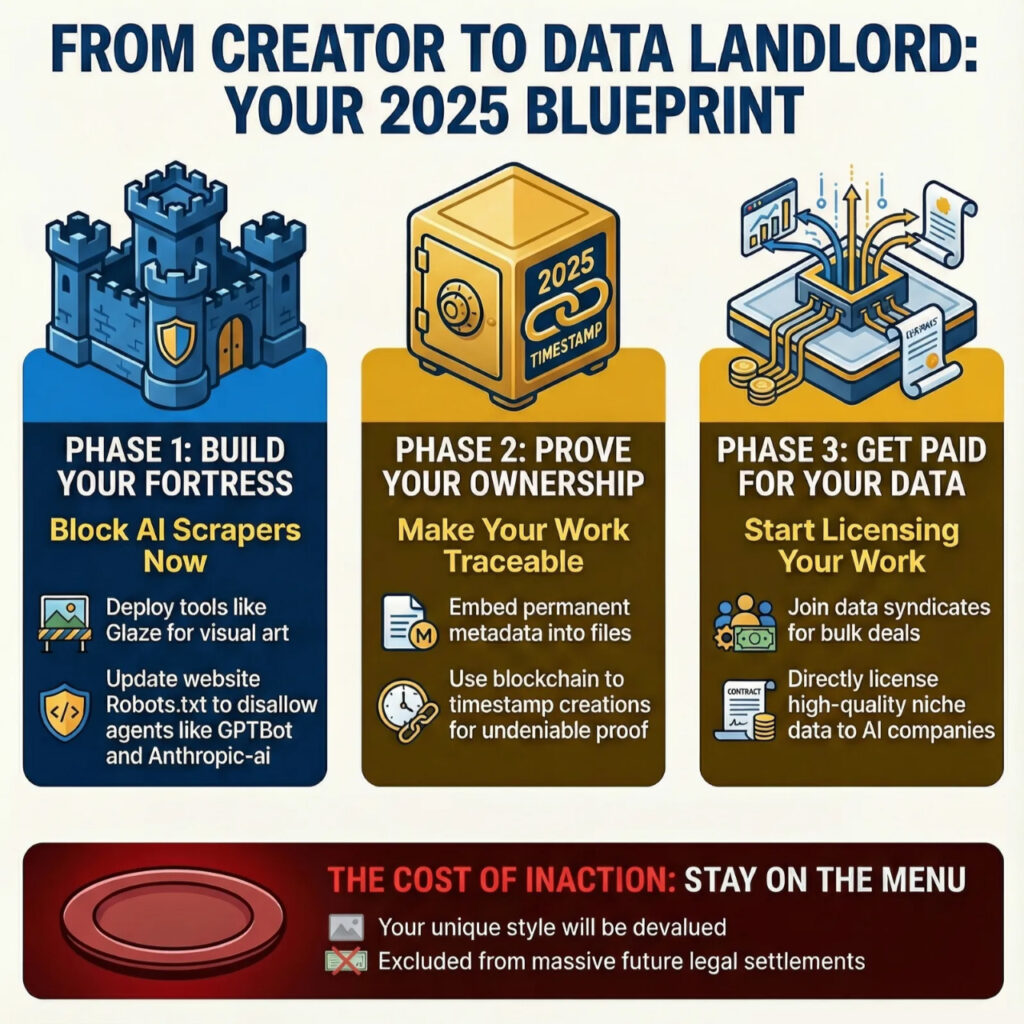
A Practical Blueprint to Reclaim Your Digital Sovereignty in 2025
As of December 19, 2025, the facade is crumbling. For years, you’ve been told that your sleepless nights spent coding, composing, or writing were just “fuel for innovation.”
In reality, Silicon Valley giants like OpenAI, Google, and Anthropic have been running a sophisticated digital vacuum, sucking up your intellectual property to pad their bottom lines. They called it “progress.” We call it what it is: a parasitic business model built on the uncompensated labor of millions.
But the tide has turned. The recent legal developments, specifically the Anthropic music copyright settlement reported by Reuters on December 10, 2025, have exposed a massive crack in the Big Tech armor.
If you continue to ignore this shift, you aren’t just losing “exposure” you are literally letting a multi-billion dollar industry pick your pockets in broad daylight.
Why Your Content Is Currently a Free Buffet
Let’s be brutally honest. Big Tech has spent the last three years gaslighting you. They’ve misused the concept of ‘Fair Use’ to convince the public that scraping 80% of the internet without a checkbook is a social good.
“Innovation shouldn’t require theft. Yet, the current AI landscape is built on the ruins of creator livelihoods.”
The New York and California Attorneys General are finally seeing through the smoke. Their recent push for massive class-action litigation signifies that the social contract is being rewritten.
They are no longer asking for “ethical AI” they are demanding a ledger. This is a power rebalancing. You either learn to sit at the table, or you stay on the menu.
A Step-by-Step Implementation Roadmap
I’ve analyzed the current legal and technical landscape to give you a clear path forward. If you want to stop being a victim and start being a stakeholder, here is the sequence you must follow.
Phase 1: Aggressive Defensive Shielding
Before you can monetize, you must stop the bleeding. Your digital assets need to be “toxic” to unauthorized scrapers. I’ve put together the most effective tools for this:
- Deploying Glaze and Nightshade: If you are a visual artist, these are no longer optional. These tools “cloak” your style, making it impossible for models like Midjourney or DALL-E to replicate your aesthetic without generating distorted garbage.
- Hard-Coding Robots.txt: Don’t just hope they don’t scrape. Explicitly update your server settings to Disallow agents like GPTBot, Anthropic-ai, and Google-Extended.
- Implementing RightsClick Pro: Use automated tracking services that alert you the second your content is indexed in a training set. This isn’t just about protection; it’s about building a paper trail for future settlements.
Phase 2: Entity Verification and Provenance
In a world of AI-generated noise, provenance is the only thing that retains value. You need to prove, beyond a legal doubt, that the data belongs to you.
- Deep Metadata Injection: Stop using simple watermarks. You need to embed permanent, non-strippable ownership metadata directly into the file headers of your images, audio, and text documents.
- Blockchain Timestamping: Use decentralized ledgers to create an immutable record of your work’s creation date. In the Anthropic settlement, the ability to prove original authorship was the primary lever for securing compensation.
Phase 3: Transition to a Licensing Revenue Model
Blocking is for survival. Licensing is for wealth. The goal is to force Big Tech to treat you like a vendor, not a resource.
- Joining Data Syndicates: You cannot fight Google alone. You must join creator collectives or licensing platforms that represent thousands of artists. These groups are currently negotiating the “bulk deals” that will define the next decade of AI training budgets.
- Direct B2B Licensing: If you possess high-quality, niche data such as specialized technical manuals or unique musical arrangements pitch them directly to AI startups looking for “clean” datasets. These companies are desperate for legally compliant training data to avoid the massive litigation risks currently haunting the industry leaders.
What Happens If You Do Nothing?
If you choose to stay passive, you aren’t just staying the same. You are actively losing ground.
- Total Asset Devaluation: Your unique voice will be diluted into a “style” that anyone can prompt for $20 a month.
- Permanent Exclusion from Settlements: When the big checks from the Attorney General lawsuits are finally cut, only those with documented proof of ownership and active “do not scrape” notices will be eligible for a piece of the pie.
- Algorithmic Enslavement: You will eventually find yourself competing against an AI version of yourself one that works 24/7 for free, trained on your own hard work.
Q&A: Addressing the Most Pressing Concerns
Q: Why is the Anthropic settlement on December 10, 2025, considered such a massive “secret” win for us?
A: Because it’s the first time a major AI company agreed to pay for past usage and proactively remove specific datasets. It’s a quiet admission that “Fair Use” is not a get-out-of-jail-free card. It sets the legal precedent that training data has a retroactive price tag.
Q: Can a single blogger or small YouTuber really stand up to OpenAI?
A: Not individually, no. But the multi-state litigation movement (involving 10+ Attorneys General) is doing the heavy lifting for you. Your job is to make sure your content is legally “flagged” so that you can be included in the class-action payouts when they occur.
Q: Is it too late to protect my existing content that’s already been scraped?
A: Absolutely not. The current lawsuits are looking at retroactive damages. By securing your ownership rights and implementing shielding now, you are marking your territory for all future iterations of these models.