
Your dermatologist isn’t just looking at your wrinkles. They’re timing how fast your skin calms down after irritation. That recovery speed? It’s the difference between looking your age and looking five years older. The wild part is it’s mostly fixable, but not the way you think.
I used to think “aging well” was about genetics. You know, those women who casually mention they’re 52 and you’re like, “No way, I thought you were 40.” I figured they just won the skin lottery.
Then my dermatologist friend told me what she actually looks for during consultations, and it completely changed how I think about skincare.
It’s Not About Sensitivity. It’s About Bounce-Back Time

Here’s what clinics actually check. How fast does your skin return to normal after stress?
Not “does it freak out” but how long does it stay freaked out?
When they press your skin lightly, or after a treatment, they’re watching the clock. Does that redness fade in 20 minutes? Two hours? Is it still there by evening?

That window, that recovery lag, is where the age gap shows up. And honestly? It’s been staring me in the face for years, I just didn’t know what I was looking at.
The Signs I Totally Missed (Until I Couldn’t)
Looking back, my skin was trying to tell me something.
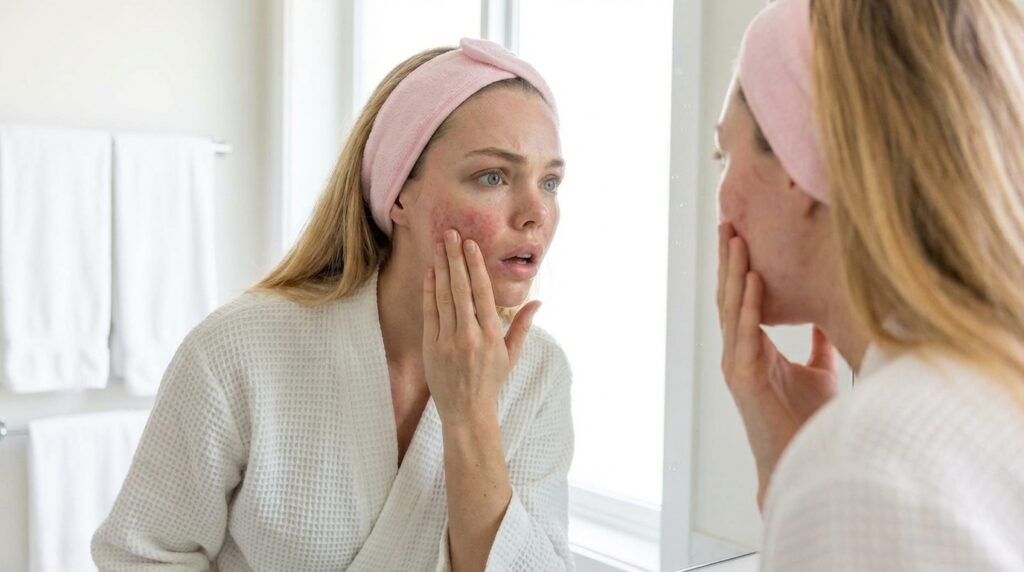
- Products that used to feel fine suddenly stung
- Post-wash tightness lasting way past 10 minutes
- Red marks from washing my face still visible at lunch
- Makeup looking weird, not my technique, but like my skin texture shifted overnight
- Breakout marks taking days to fade instead of clearing by morning
I thought I was just “getting sensitive.” Turns out, my skin’s recovery speed was slowing down, and every small delay was stacking up.
The Causality Chain That Wrecked Me

Here’s the trap I fell into. Maybe you’ll recognize it.
My skin felt dry, so I added more actives like vitamin C, retinol, and acids. Those irritated my already compromised barrier. Irritation slowed recovery. Slow recovery made me look more tired and dry, so I added more products.
See the loop? I was treating the symptom by creating more of the problem.
By the time I figured it out, my face was in this constant low-grade angry state. Not breaking out, not flaking dramatically, just perpetually “off.” Foundation wouldn’t sit right. My skin looked dull by 2 PM. I felt like I aged three years in six months.
What Actually Changed Things (The Unsexy Truth)

I didn’t fix it by finding some miracle serum. I fixed it by removing friction and giving my skin actual time to repair.
The Reset That Worked
For four weeks, I did the most boring routine imaginable.
Morning: Splash with lukewarm water, basic moisturizer with ceramides, sunscreen
Night: Gentle cleansing oil (if I wore makeup), creamy cleanser, same moisturizer
No acids. No retinol. No vitamin C. No actives at all.
Just barrier support and defense against UV.
What Happened (Week by Week)
Week 1: Honestly? I felt like I was doing nothing. My skin looked fine? Not glowing, not terrible. Just calm.
Week 2: The tightness after washing disappeared. I stopped instinctively reaching for extra layers of toner because my face didn’t feel parched.
Week 3: Redness from washing faded within 30 minutes instead of hanging around all morning. Makeup started sitting better.
Week 4: My skin looked like it got more sleep than I actually did. That constant “tired face” thing? Gone.
The change wasn’t dramatic. It was cumulative. Like my skin finally stopped playing defense and could just exist.
The Three Changes That Made the Biggest Difference
I Stopped Over-Cleansing

I switched to a pH-balanced, non-foaming cleanser that didn’t leave my face squeaky. Turns out, that “clean” feeling was actually “stripped,” and it was setting me back every single day.
I Locked in Moisture Immediately
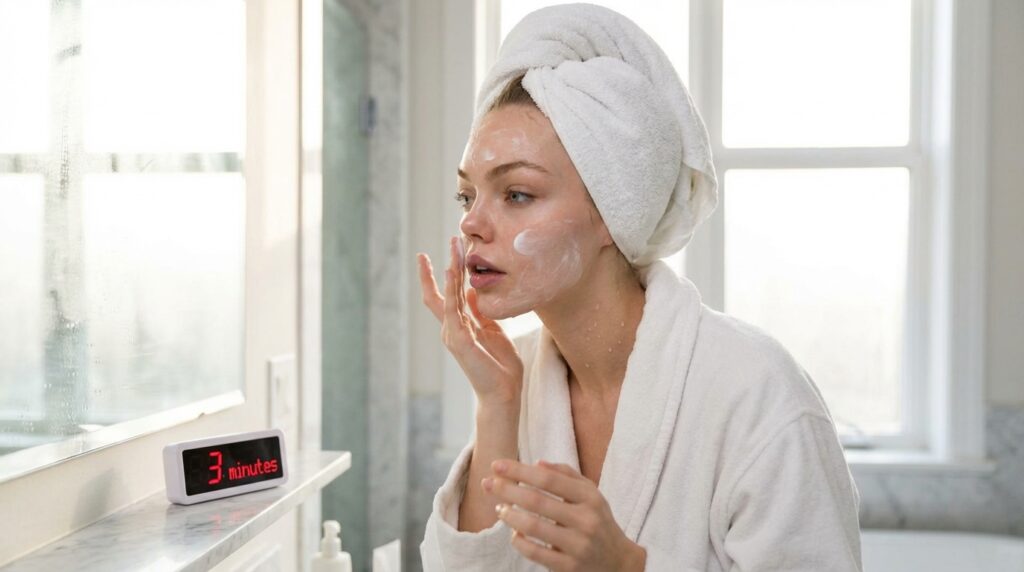
Within three minutes of cleansing, not after scrolling my phone, not after doing my hair, I applied moisturizer. That tiny timing shift kept my skin from starting every routine in hydration debt.
I Treated Sunscreen Like Medicine, Not Makeup

Every. Single. Day. Even when I wasn’t leaving the house. UV exposure was sabotaging my recovery without me realizing it.
When I Brought Actives Back (Slowly)
After that four-week reset, my skin could actually handle the “good stuff” again.
I reintroduced retinol once a week. Then twice. Then every other night. Slowly, like a normal person, instead of my previous “more is more” chaos.
The difference? This time, my skin didn’t revolt. No stinging, no prolonged redness, no regression. Because I wasn’t asking it to perform miracles while simultaneously breaking down its defenses.
The Real Anti-Aging Metric No One Talks About

It’s not “do you use retinol” or “how much did that serum cost.”
It’s this. When your skin gets stressed, how fast does it recover?
Because that speed, or lack of it, is what actually shows on your face. Not as one dramatic wrinkle, but as a general “tired” look that’s hard to pinpoint but impossible to ignore.
The women who seem to age slowly? Their skin doesn’t hold grudges. It processes stress and moves on. Mine was holding onto every little thing, and it showed.
What I’d Tell My Six-Months-Ago Self
Stop chasing glowing transformations. Start tracking recovery time.
If your skin takes hours to calm down after washing, or if new products reliably sting, you don’t need more products. You need fewer.
Give your barrier 2 to 4 weeks to rebuild with the simplest possible routine. Gentle cleanser, barrier-focused moisturizer, sunscreen. That’s it.
It won’t feel like you’re “doing enough.” Do it anyway.
Then, when your skin stops acting like every day is a crisis, you can add back the actives. Slowly. One at a time. Like someone who actually wants them to work.
The bottom line?
Same age, different skin ages, not because of luck, but because of recovery speed. And recovery speed is something you can actually control, once you stop mistaking “intense” for “effective.”
Mine got better. Yours can too.